
Calculate engine/motor RPM based on desired speed and wheel diameter. Optional gear ratio can be specified for drive train calculations.
The MPH to RPM Calculator converts miles per hour (MPH) to revolutions per minute (RPM), a critical task in automotive and mechanical engineering. MPH measures linear speed (distance traveled per hour), while RPM quantifies rotational speed (rotations per minute). Their relationship is vital for optimizing engine efficiency, tire performance, and vehicle diagnostics.
For instance, the MPH to RPM Calculator determines wheel rotations for a car traveling at highway speeds or calculates RPM for industrial machinery based on linear motion. This ensures precise tuning and operational efficiency.
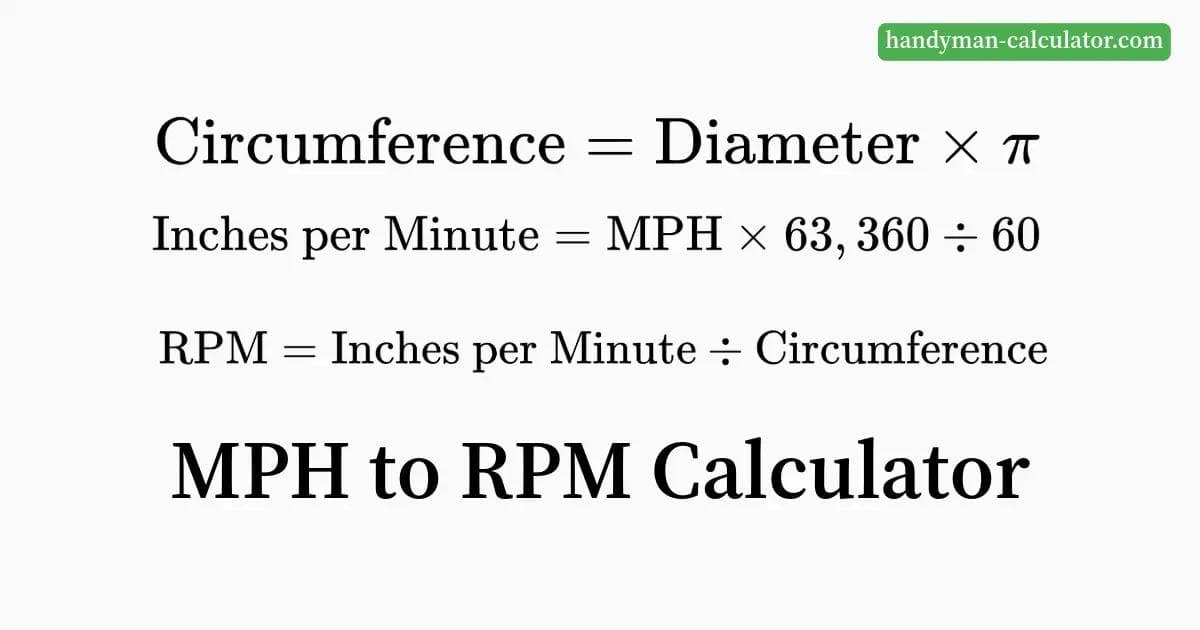
The circumference of a circle is critical in converting between RPM and MPH. It is the distance around the circle, calculated using the formula:
Circumference = Diameter × π
If the diameter of a rotating object is 36 inches, its circumference is:
36 × 3.14159 = 113.1 inches
Circumference is also crucial in other conversions, such as Feet per Minute to RPM and vice versa.
To effectively perform the conversion of miles per hour to revolutions per minute and calculate RPM from MPH, use this step-by-step formula:
By following these steps, you gain a clear understanding of the MPH and RPM relationship and how to convert between the two.
Let’s illustrate this with an example: calculating the engine rotation (RPM) of a vehicle traveling at a speed of 152 MPH, assuming a tire diameter of 36.4 inches:
To calculate the RPM for your given speed:
The calculator will show you the Revolutions Per Minute (RPM) for your entered speed, along with the wheel RPM if you've included a gear ratio. You'll also see the results converted to metric units for convenience.
For reverse calculations, check out our RPM to MPH Calculator.
A: While gear ratio can affect final RPM in vehicles, our calculator focuses on direct wheel/object rotation. For engine RPM calculations, you'll need to multiply the result by your vehicle's gear ratio.
A: A larger diameter means more distance covered per rotation, resulting in fewer RPMs needed for the same MPH. This is why accurate diameter measurement is crucial for precise calculations.
A: While the calculator provides mathematically precise results, several real-world factors can influence actual measurements: Tire pressure and deformation Surface conditions and traction Mechanical wear and tear Temperature effects on material expansion Bearing efficiency